The Ham
Archive: The Ham
A history of salt, smoke, and place
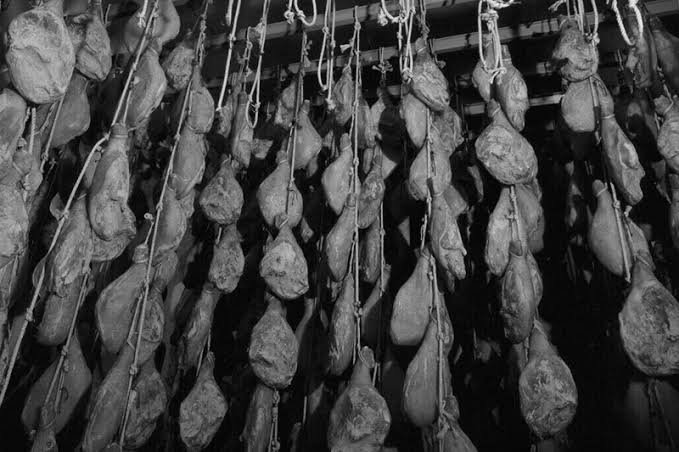
A ham begins as a hind leg. That much is simple. The rest is a series of human decisions. Someone raised the pig, chose the day to slaughter it, found enough salt, made room for the leg to cure, watched the weather, and perhaps lit a fire beneath it. By the time the meat reached a table, it carried the work of many hands and the conditions of a particular place. That is the history inside a slice of ham.
The question was once urgent: what do you do with a whole animal when there is no refrigerator? Fresh pork could be cooked and shared immediately, but a family needed food after the day of slaughter. The ham, a large, valuable cut, could be salted and dried for later use. Smoke might add another layer of flavor and protection. Neither salt nor smoke worked by magic. Their effectiveness depended on quantities, temperature, time, moisture, and the judgment of people who had learned to read the meat and the season.
Before there was a Southern ham
There is no single birthplace of ham. Archaeological work identifies at least two early centers of pig domestication: one in western Asia near the eastern edge of Anatolia around 8500 BCE, another in China’s Yellow River region around 6500 BCE. This establishes a long history of people living with and raising pigs. It does not give us a first ham, a first cure, or one unbroken recipe leading to the American South. The animal and the preservation practice have related but different histories.
Many societies learned to preserve pork with salt, drying, and sometimes smoke. Their results were shaped by the local climate, the pigs they raised, the salt they could obtain, the rooms where meat could hang, and the flavors they preferred. Spanish jamón, Italian prosciutto, and Southern country ham all invite comparison because they begin with a leg and depend on preservation. They are not interchangeable, and resemblance alone does not establish that one was copied directly from another. The better question is what each place required its makers to do.
The pig crosses the Atlantic
European colonists brought domestic pigs and established pork curing practices into North America. The Southern food world that formed around them was never solely European. Indigenous peoples had their own knowledge of the land and cooking with fire; Africans and their descendants shaped foodways through knowledge, labor, and adaptation under vastly different circumstances. Pork cooking in the South grew through these encounters, but barbecue, a meal cooked over heat, should not be confused with the long preservation of an intact ham. They share a pig and may share smoke. They answer different questions.
By the eighteenth century, Virginia records let us watch pork move from an animal to stored food and then to trade. Colonial Williamsburg’s research collects a journal entry from December 1774 describing 35 hogs killed on one property. The writer said the hams and shoulders were cured with saltpeter and that the salted pork was meant to last until the following year. Another account from 1774 describes salted pork leaving Alexandria for the West Indies. Those details are specific: one slaughter, one observer, one trading route. Together they show that cured pork fed households and circulated beyond them.
December was no accident. Cool weather made slaughter and the first stages of preservation more manageable before dependable mechanical refrigeration. A large hog yielded fresh meals, shoulders and hams to cure, bacon, sausage, and fat to render. The work turned one day of abundance into many months of cooking. Salt had to be available, and the meat needed a place to drain, dry, hang, and remain secure. A recipe alone cannot show that whole system.
The smokehouse and the hands that filled it
Colonial Williamsburg identifies a Virginia reference to a “smoke house” in 1716. A 1732 order called for an eight foot square building with a plank door. The door tells part of the story: the meat was worth protecting. A smokehouse could serve as a storehouse long after the fire went out, which helps explain the alternate name “meat house.” The building held the result of raising, slaughtering, butchering, salting, and tending, not merely the result of a few hours beside a fire.
The building also raises a question that Archive has to ask: whose work appears in the record? A property owner’s name might survive in an account while the people who fed hogs, cut joints, managed fires, and cooked the finished meat remain unnamed. Monticello’s records show salted pork among rations given to enslaved families. We should be exact about what that means. Salted pork is not necessarily a ham, and a ration record does not establish that the people who performed the work ate the same cuts served at an owner’s table. It does reveal that access to pork was unequal.
Sometimes even a building’s name promises more than the evidence delivers. At Melrose in Natchez, Mississippi, a structure is known as the smokehouse. The National Park Service reports no salt or ash in the soil beneath it and no evidence that meat was smoked there. Hogs were not raised on that estate; meat may have been processed at another property and brought in. The building may have stored food. “Smokehouse” is therefore the name we have, while its actual use remains a narrower, more interesting question. That is what research can do: make a familiar label strange enough to examine.
Written accounts describe quantities and transactions. Family memory often remembers the day itself. In a 1977 interview preserved by the Library of Congress, Janie “Ma” Nelson recalled hog killings in Georgia in fall or around Christmas. Neighbors came together. People butchered, rendered lard in large pots, and cooked fresh pork with greens, biscuits, and other food for those working. Her recollection gives sound and movement to a process that an inventory might reduce to pounds of meat.
Nelson was remembering a particular family and time. Her account cannot be laid over every Southern farm, and it cannot tell us exactly what happened in Virginia in 1774. It can tell us that hog killing, for people she knew, involved neighbors and a meal as well as preservation. Both kinds of evidence matter. The written record fixes a date; memory can recall how a day felt. Neither should be made to say more than it does.
Refrigeration changed the necessity that once governed the work. Curing no longer has to carry an entire household from one slaughter season to the next. Yet the food remains. Country ham is usually a dry cured leg, often aged and sometimes smoked, with a concentrated, salty character. A moist, cooked smoked ham follows another process and eats differently. Even within those broad names, makers choose different levels of salt, smoke, aging, and slicing. The place and the maker still matter.
If we taste an old style ham beside a modern moist ham, the difference is more than nostalgia. Water leaves a dry cured leg; USDA explains that dry curing commonly reduces its weight by roughly 20 to 25 percent. Flavor becomes concentrated. A thin slice can season a biscuit, a pot of beans, or a plate without needing to be the whole meal. Smoke may announce itself immediately or sit quietly beneath the salt. None of those sensations can tell us the name of the person who made the ham, but they can lead us back to the choices that person made.
The Archive question is not “Who invented ham?” It is: where was this pig raised, how was this leg preserved, what conditions made that method useful, who performed the work, and which of those answers can we actually document? A ham is a cut of meat. The history is everything people did to make it last—and everything we can still learn by paying attention.