What a free culinary job program offers
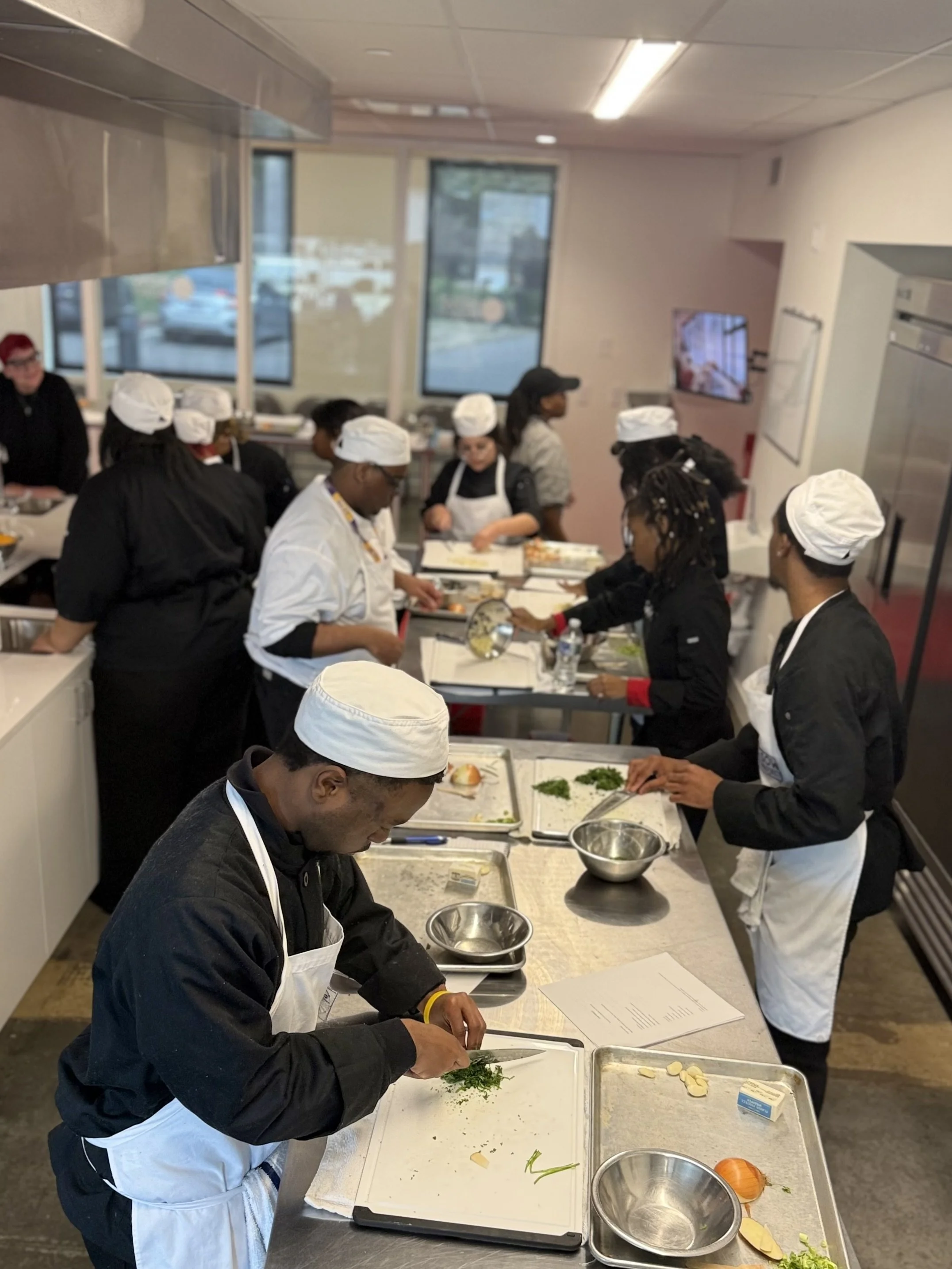
Sow Project students working independently on culinary curriculum
A lot of people do not need motivation. They need a fair shot.
That is what a free culinary job training program should provide. Not a brochure full of promises. Not a pile of debt. Not a classroom disconnected from real kitchens. A real path into culinary work, built for people who have talent, work ethic, and ambition, but have been blocked by cost, healthcare gaps, unstable schedules, transportation issues, or a lack of hiring access.
For anyone trying to build a future in food service, the difference matters. A good program does more than teach knife skills or recipes. It clears the path between training and employment, because training without a job at the end is not opportunity. It is delay.
What makes a free culinary job training program different
Traditional culinary education often asks students to take a risk first and hope the return comes later. Tuition can be high. Supplies add up fast. And even after graduation, many students still have to figure out how to get hired, how to stay healthy enough to work, and how to manage the financial pressure that follows them into the job market.
A free culinary job training program flips that model. It starts with the reality students are living in right now. If someone cannot afford tuition, then tuition cannot be the gatekeeper. If uniforms, textbooks, transportation support, healthcare access, or work-readiness coaching make the difference between finishing and dropping out, then those supports are not extras. They are part of the job training itself.
That is the first major distinction. The second is just as important: outcomes. A serious workforce program is not built around enrollment numbers or certificates alone. It is built around whether students complete training, enter the workforce, earn livable wages, and stay on a path to long-term stability.
Training should lead somewhere
In culinary work, experience matters. Employers want people who can handle pace, follow systems, show up ready, and contribute on day one. So the best programs do not separate education from employment. They connect them.
That means students need professional culinary instruction, but they also need workplace readiness, interview preparation, financial literacy, and direct access to employers who are ready to hire. Without that bridge, even strong students can get stuck between completion and actual employment.
This is where many programs fall short. They may offer basic classes, but not a hiring pipeline. They may teach technique, but not the habits that keep someone employed. They may celebrate graduation, but not track what happens after. For students trying to change their lives, that gap is not small. It is everything.
A workforce-centered model treats job placement as part of the promise, not a bonus feature. It recognizes that the goal is not simply to train people for kitchens. The goal is to help people build stable working lives through culinary careers.
Why free is only part of the story
Free matters. It removes one of the biggest barriers at the door. But free by itself does not guarantee access, and it certainly does not guarantee completion.
A student can enter a no-cost program and still struggle if they are choosing between class and a medical need, if they do not have the right equipment, or if they are trying to navigate financial stress with no support. That is why the strongest programs are holistic. They understand that people do not leave their real lives outside the classroom.
When training includes uniforms, textbooks, practical support, and help addressing healthcare or work-readiness barriers, students are far more likely to finish what they start. Not because they were given an easier path, but because the unnecessary obstacles were removed.
There is a difference.
Removing obstacles honors effort. It does not replace it. Students still have to show discipline, consistency, and commitment. They still have to learn the craft. They still have to earn trust in the kitchen. But they should not have to fight preventable barriers at every step just to prove they belong.
What students should look for in a program
Not every free training option offers the same value. Some are short-term introductions. Others are stronger on classroom instruction than job placement. Some may be a good fit for a person who wants exposure to the industry, while others are designed for people who want a direct route into employment.
If you are considering a free culinary job training program, look beyond the word free and ask better questions. What will you actually learn? Will you receive professional instruction that reflects the standards of a real kitchen? Are uniforms and materials included? Is there support for workplace readiness, financial literacy, or healthcare access? Most importantly, what happens when training ends?
If the answer is vague, that tells you something. A strong program should be able to explain exactly how it supports students from day one through job placement. It should be clear about expectations, honest about the work involved, and confident about outcomes.
That confidence matters. Students deserve more than inspiration. They deserve structure.
Why employers should care too
A strong culinary workforce does not appear by accident. It has to be cultivated.
Restaurants, hospitality groups, healthcare food service teams, and institutional kitchens all depend on reliable talent. Yet many employers say the same thing: they need people who are trained, prepared, and ready to work. The problem is not a lack of human potential. The problem is that too many talented people are locked out before they ever reach the hiring table.
A serious training-to-employment model changes that. It gives employers access to candidates who have been taught technical skills and workplace expectations in a structured environment. It also creates a better hiring process, because employers are not starting from scratch each time they need staff. They are plugging into a talent pipeline built with intention.
That is good for business, and it is good for the region. When more people can enter stable work without taking on debt, local economies get stronger. Turnover pressure can ease. Families gain income. Communities keep talent that might otherwise be sidelined.
This is one reason workforce development deserves to be taken seriously as economic infrastructure, not treated as charity branding.
Why supporters are funding outcomes, not optics
For donors, partners, and community leaders, the question should never be whether people want to work. The question is whether systems are designed to recognize and develop the talent that already exists.
A program that combines culinary education with wraparound support and guaranteed job placement is not offering temporary relief. It is building earning power. That creates a different kind of return.
The Sow Project stands in that space with moral clarity. It is not asking people to fund vague possibility. It is investing in a workforce model that treats students with dignity and ties support directly to measurable employment outcomes.
That approach matters because too much public conversation still frames workforce barriers as personal failings. In reality, many people are doing everything they can with too little support and too few openings. When a program removes tuition, addresses practical barriers, and connects training to livable-wage employment, it proves something simple and powerful: talent is widely distributed, but access is not.
The right program respects both ambition and reality
Culinary work is demanding. The hours can be long. The standards are high. Advancement takes consistency. Any honest program should say that clearly.
But honesty also means acknowledging that many aspiring workers are not looking for a hobby or a feel-good class. They are looking for a real career path. They want to support themselves, contribute to a team, and build something steady. They do not need to be rescued. They need a training environment that respects their ambition and meets reality head-on.
That is the promise of a well-built free culinary job training program. It does not ask students to carry the full burden alone. It teaches, equips, supports, and connects. It recognizes that skill matters, but so do structure, access, and follow-through.
If you are a prospective student, look for the program that believes your future should not depend on your ability to pay upfront. If you are an employer, look for the partner that understands talent development as a serious workforce function. If you are a supporter, back the model that turns potential into paychecks.
A fair shot should not be rare. It should be built on purpose.