North Mississippi Job Training That Leads to Actual Work
A lot of people do not need another program that promises transformation “someday.” They need work, a fair shot, and training built around the reality of bills, transportation, healthcare, and family responsibility. That is the real conversation around workforce development in North Mississippi and throughout the Mid-South. The question is not whether people are willing to work. The question is whether training programs are actually designed to carry people all the way to employment.
Too often, they are not.
A class may teach a skill, but leave students to figure out uniforms, transportation, childcare, job placement, or how to navigate a professional kitchen on day one. That gap matters. Training without support can still leave strong candidates locked out of opportunity. For many people trying to enter or re-enter the workforce, the difference between momentum and frustration is not talent. It is whether the path has truly been cleared.
What Workforce Training Should Actually Deliver
Workforce development is often framed as education alone. In reality, strong training programs must do far more than teach a trade.
A serious program should:
Build practical, employable skills
Connect directly to real jobs and employers
Remove barriers that prevent completion
Support long-term employment retention
Create dignity, confidence, and financial stability
If a person completes months of coursework but leaves without a direct line to employment, the model is incomplete. If training creates debt before a first paycheck arrives, the system is working against the student. If someone learns well in the classroom but cannot afford the tools needed to succeed professionally, the opportunity remains out of reach.
That reality matters deeply across North Mississippi and the greater Memphis region, where many adults are balancing career changes, job loss, childcare responsibilities, or re-entry into the workforce without a financial safety net.
The best workforce programs understand that education and employment cannot be separated.
Why Barrier Removal Matters
One of the biggest misconceptions in workforce development is the idea that people fail because they lack potential. In many cases, talented individuals are pushed out by preventable barriers.
Transportation.
Healthcare access.
Uniform costs.
Childcare.
Professional confidence.
Financial literacy.
Reliable mentorship.
These challenges are not secondary issues. They directly impact whether someone can complete training, secure employment, and remain employed long term.
That is why modern workforce training must combine skill development with wraparound support systems that stabilize the student while they learn.
In culinary workforce development specifically, this matters even more. Professional kitchens require stamina, communication, consistency, urgency, professionalism, and teamwork from day one. Students need more than recipes and knife skills. They need structure, accountability, mentorship, and real-world preparation.
The strongest programs recognize this and build support directly into the model rather than treating it as an optional add-on.
The Difference Between Credentials and Careers
Not every training program is solving the same problem.
Some programs are designed to issue certificates.
Others are designed to create access to lasting employment.
Those are not always the same thing.
A credential alone does not guarantee placement, wages, or long-term stability. For most students, the more important question is simple:
What happens after training ends?
Is there a direct employer pipeline?
Are hiring partners involved?
Is placement part of the model?
What are the retention rates?
What are graduates actually earning?
Outcome-driven workforce programs begin with employment as the goal and build training backward from the realities of the labor market. They focus on measurable results:
Completion rates
Job placement
Wage growth
Retention
Long-term career development
Compassion matters. But compassion without structure does not build sustainable workforce systems.
Why Culinary Training Matters
The culinary industry is often misunderstood.
People see restaurants and assume temporary work, low-skill labor, or limited career growth. In reality, professional kitchens teach some of the most transferable workforce skills available:
Communication under pressure
Time management
Teamwork
Precision
Leadership
Adaptability
Discipline
Professional standards
For many students, culinary training is also deeply tangible. Progress is visible. Skills build quickly through repetition and real service experience. Students move from foundational knife skills and sanitation into production, service, organization, leadership, and operations.
The work is demanding, but it is real.
In regions where workers need practical pathways to stable employment, culinary workforce training can provide immediate access to opportunity without requiring years of traditional education debt.
That is especially important across North Mississippi and the Mid South, where employers continue to need trained hospitality professionals, food service leaders, bakers, prep cooks, line cooks, and operations staff.
What to Look for in a Workforce Training Program
Not every training program is built equally. Students and supporters should look closely at how programs are structured.
Strong workforce programs should offer:
Direct job placement pathways
Employer partnerships
Hands-on learning
Practical workforce preparation
Wraparound support services
Clear wage outcomes
Retention-focused support
Real accountability metrics
It is also important to evaluate how a program treats people.
The best workforce organizations do not speak down to students or position them as charity cases. They recognize talent, expect professionalism, and provide the support needed for students to succeed.
That combination of dignity and accountability changes outcomes.
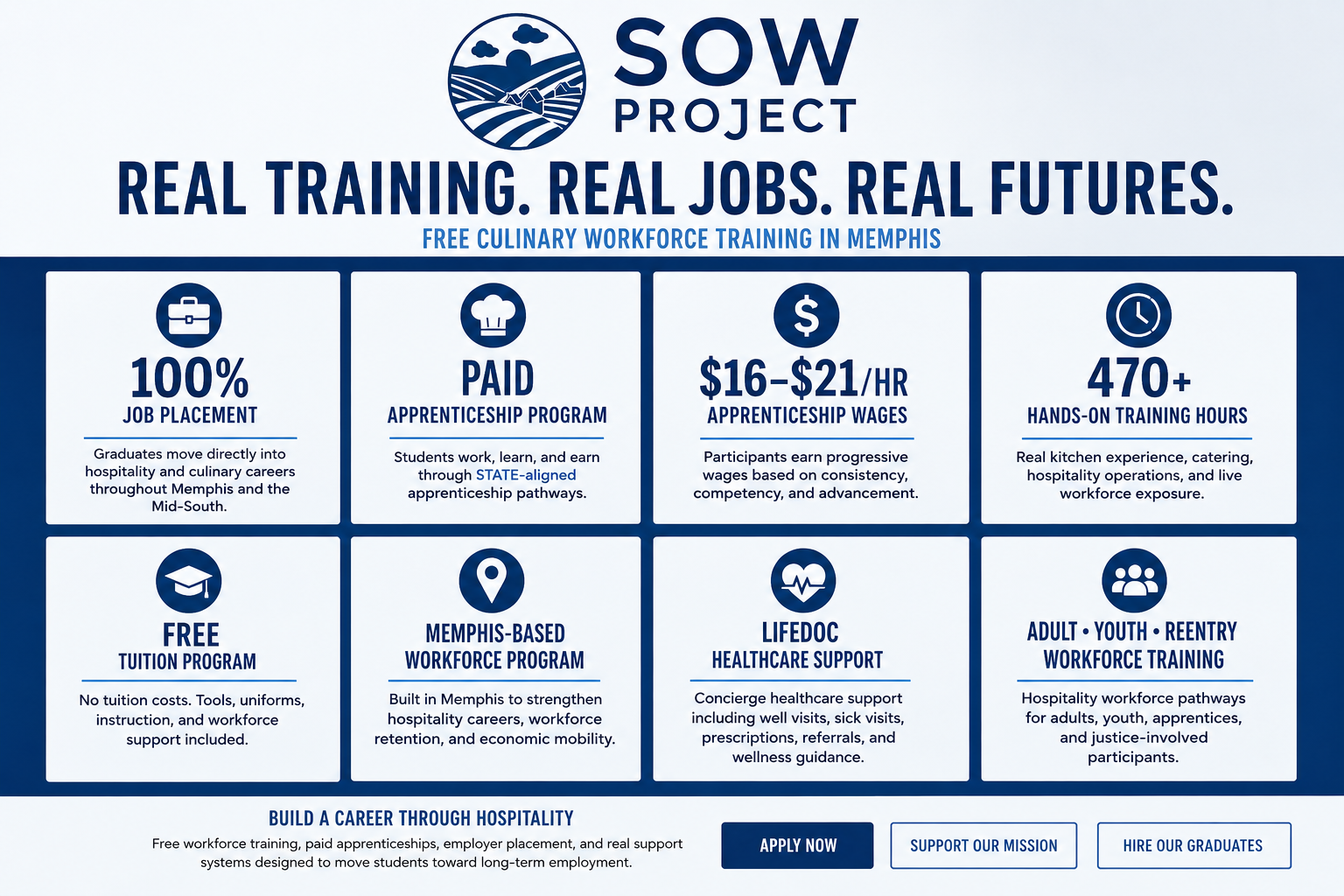
One example of this model is The Sow Project, which approaches culinary workforce development through free hands-on training, wraparound support services, apprenticeships, and direct job placement pathways. The program is built around the belief that workforce training should lead directly to stability, wages, and long-term opportunity.
Why Workforce Investment Matters
For donors, employers, school systems, and community leaders, workforce development is not simply charity. It is infrastructure.
When people can access high-quality training without taking on debt:
Employers gain prepared talent
Families gain income stability
Communities gain economic momentum
Local industries become stronger
Public systems experience less strain
The return on investment becomes measurable and long-lasting.
But design matters.
Low-touch programs may serve large numbers quickly, but often struggle with completion and retention. High-support, employment-focused models require more coordination and investment, yet consistently produce stronger long-term outcomes.
The future of workforce development will belong to organizations willing to combine education, employer connection, mentorship, accountability, and barrier removal into one system.
North Mississippi and the Mid South do not need more training that stops at the classroom door. They need pathways that connect directly to employment and treat people with dignity, expectation, and belief in their potential.
Because when training is practical, free, and tied to real opportunity, people gain more than skills.
They gain traction.
And traction changes everything